
Rick Grimes’ exit from The Walking Dead remains one of the most talked-about moments in the series’ long history. As the central character since the show’s premiere in 2010, Rick was the emotional and narrative anchor of the story. His leadership, moral struggles, and evolution from a small-town sheriff to a hardened survivor defined the series for nearly a decade. So when Rick suddenly left in Season 9, it raised a major question among fans: why did Rick leave The Walking Dead?
The answer involves both in-universe storytelling and real-world decisions made by actor Andrew Lincoln. His departure was not simply a creative twist but a carefully planned exit that balanced character closure with future storytelling possibilities. Rick’s final episode delivered an emotional farewell while leaving the door open for his return.
This article breaks down exactly why Rick left The Walking Dead, what happened in his final episode, and how his exit shaped the future of the franchise.
Rick Grimes’ Role in The Walking Dead
Rick Grimes is introduced as the protagonist of The Walking Dead, a former sheriff’s deputy who wakes up from a coma to find the world overrun by walkers. From the very beginning, his journey is about survival, leadership, and maintaining humanity in a collapsing world.
Over the course of eight seasons, Rick becomes the leader of multiple communities, including the Atlanta group, the prison survivors, and Alexandria. His decisions often carry life-or-death consequences, making him one of the most complex characters in the series.
Rick’s character arc is defined by constant change. He evolves from a hopeful leader who believes in rebuilding society into someone willing to make brutal decisions for the sake of survival. This transformation makes his eventual exit even more significant.
By Season 9, Rick is attempting to build a new future rather than simply survive. This shift sets the stage for his departure.

What Happened in Rick’s Final Episode?
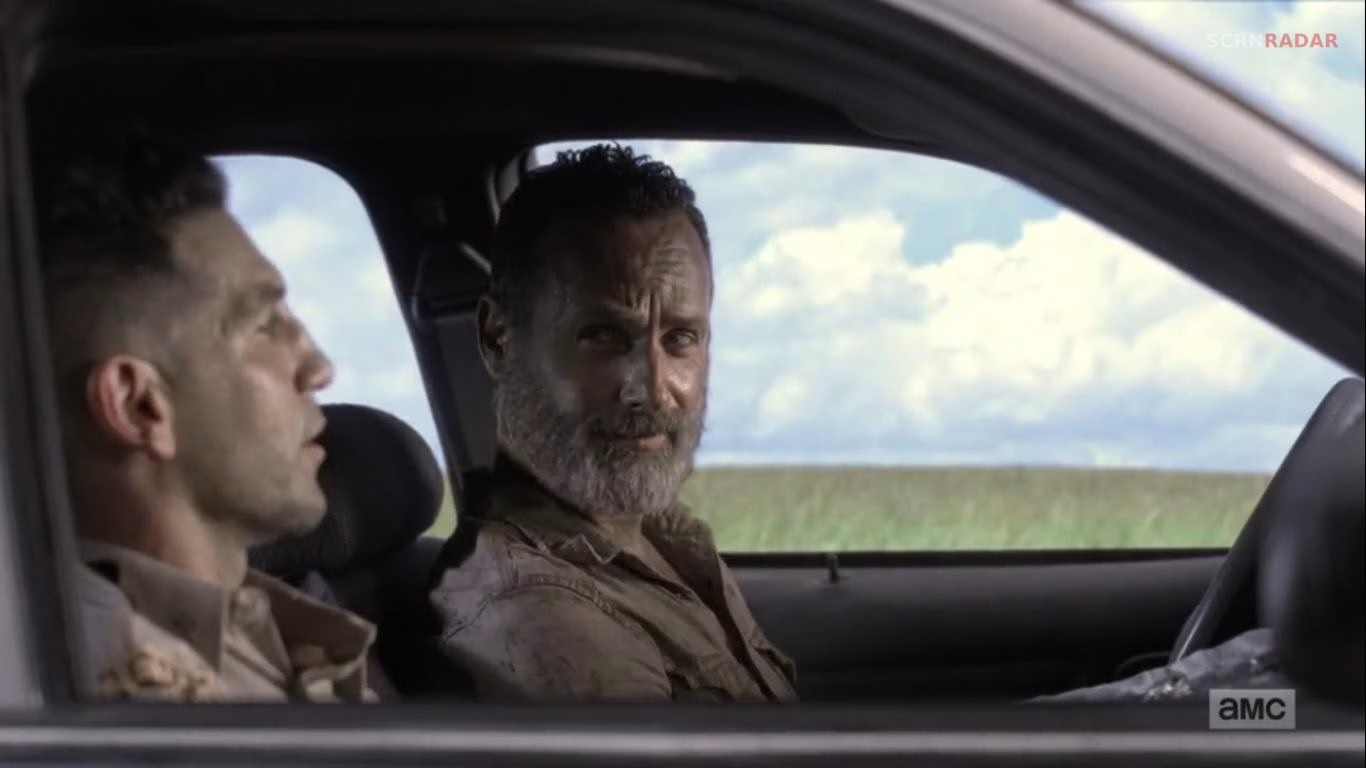
Rick Grimes’ final episode occurs in Season 9, Episode 5, titled “What Comes After.”
The episode begins with Rick severely injured after being impaled on a piece of metal during a bridge explosion attempt. Despite his condition, he continues to push forward, determined to lead a herd of walkers away from his community.
Throughout the episode, Rick experiences hallucinations of past characters, including Shane, Hershel, and Sasha. These visions reflect his journey and the people who shaped him, adding emotional depth to his farewell.
In the climax, Rick destroys the bridge to stop the walker herd, seemingly sacrificing himself in the process. His friends believe he has died, marking one of the most emotional moments in the series.
However, the episode reveals that Rick survives. He is found by Jadis (Anne) and taken away in a helicopter belonging to a mysterious organization.
This twist confirms that Rick’s story is not over, even though he leaves the main series.
Why Did Andrew Lincoln Leave The Walking Dead?
The real reason behind Rick’s departure lies with actor Andrew Lincoln.
Lincoln publicly stated that his decision to leave the show was primarily driven by personal reasons. Filming The Walking Dead required him to spend long periods in the United States, away from his family in the United Kingdom.
In interviews, Lincoln explained that he wanted to spend more time with his children as they were growing older. After nearly a decade of working on the show, he felt it was the right moment to step away.
He described his departure as a difficult but necessary decision. Despite his love for the character and the series, family priorities ultimately came first.
This real-world context is crucial to understanding why Rick left. The decision was not sudden but carefully planned to allow for a meaningful exit.
Was Rick Originally Meant to Die?
One of the biggest questions surrounding Rick’s departure is whether he was supposed to die.
According to the show’s creative team, killing Rick was never the plan. Instead, the goal was to give him an open-ended exit that would allow for future storytelling.
Showrunner Angela Kang and AMC executives wanted to preserve Rick’s legacy while also keeping the possibility of his return alive. This led to the decision to have him survive and be taken away by the helicopter group.
This approach also aligns with the franchise’s expansion strategy. Rather than ending Rick’s story completely, the show transitions him into a larger narrative beyond the main series.
The choice to keep him alive ensured that fans would remain invested in his future.
The Helicopter Mystery Explained
Rick’s departure introduces one of the show’s biggest mysteries: the helicopter group.
The helicopter belongs to the Civic Republic Military (CRM), a powerful and secretive organization operating in the larger Walking Dead universe. This group has advanced resources and a structured society, making it very different from the communities seen in the main series.
Jadis’ involvement suggests that she had prior connections with the CRM. Her decision to take Rick with her indicates that he holds some value to the organization.
The helicopter storyline serves as a bridge between The Walking Dead and its expanded universe. It hints at a larger world beyond the immediate struggles of the main characters.
This mystery becomes a key part of Rick’s ongoing story.
How Rick’s Exit Affected The Walking Dead

Rick’s departure had a significant impact on the series.
As the central character, his absence forced the show to shift its focus to other characters. Daryl, Michonne, Carol, and Maggie took on more prominent roles, reshaping the narrative.
The tone of the series also changed. Without Rick’s leadership, the story explored new dynamics and conflicts within the communities.
The time jump that follows his departure allows the show to evolve and introduce fresh storylines. This transition helps maintain the series’ longevity.
While some fans struggled with Rick’s absence, others appreciated the opportunity for new characters to step forward.
Did Rick Ever Return?
Although Rick leaves the main series, his story continues in the broader Walking Dead universe.
AMC initially announced plans for a series of Rick Grimes movies that would explore his journey after leaving. These plans later evolved into a spin-off series featuring Rick and Michonne.
This continuation confirms that Rick’s exit was never meant to be permanent. Instead, it was a transition into a new chapter of his story.
Fans eventually see Rick again in later projects, providing closure to his storyline.
This long-term planning highlights how important Rick remains to the franchise.
The Emotional Impact of Rick’s Departure
Rick’s exit is not just a plot development but an emotional milestone for the series.
His journey from Season 1 to Season 9 represents the heart of The Walking Dead. Watching him leave feels like the end of an era.
The use of hallucinations in his final episode reinforces this idea. By revisiting key moments and characters, the show honors Rick’s legacy.
The reactions of other characters also emphasize his importance. Their grief reflects how central Rick was to their lives.
This emotional weight is what makes his departure so memorable.