
The ending of Station Eleven stands apart from most post-apocalyptic stories because it avoids focusing purely on survival or destruction. Instead, the finale centers on healing, memory, and the way art helps people process trauma. Across its nonlinear timeline, the series gradually connects characters whose lives were shaped by the Georgia Flu pandemic, culminating in an ending that feels both intimate and thematically complete.
By the time the final episode unfolds, viewers are not just asking what happens to the characters, but what the entire journey means. The show carefully ties together Kirsten, Jeevan, The Prophet, and Clark, revealing how their lives intersect through shared experiences and emotional scars. Rather than delivering a traditional “twist ending,” Station Eleven builds toward a resolution that emphasizes emotional closure and human connection.
Let’s break down what happens in the finale, how the storylines connect, and what the ending really means.
How the finale brings all timelines together
One of the defining features of Station Eleven is its nonlinear storytelling. The series constantly shifts between the pre-pandemic world, the early collapse of society, and the post-apocalyptic present. While this structure may seem fragmented at first, the finale reveals how carefully everything has been connected.
The Traveling Symphony’s arrival at the airport settlement becomes the central convergence point for multiple characters. Kirsten, now an adult performer, unknowingly returns to a place deeply tied to her past. Clark, who leads the airport community, represents a different kind of survival, one focused on preservation and order.
At the same time, The Prophet and his followers approach the airport, creating tension that initially feels like it will lead to violence. However, the show deliberately subverts expectations by resolving conflicts through emotional understanding rather than physical confrontation.
The finale’s structure emphasizes reunion over resolution. Characters do not simply solve problems; they reconnect with parts of themselves and each other that were lost during the pandemic.
Kirsten’s journey reaches emotional closure
Kirsten is arguably the emotional core of Station Eleven, and the finale focuses heavily on her personal resolution. As a child, she experienced the collapse of civilization and the loss of parental figures, shaping her identity as both a survivor and a performer.
Throughout the series, Kirsten carries trauma linked to her early experiences, particularly her separation from Jeevan. The graphic novel “Station Eleven,” which she has carried since childhood, becomes a symbolic tool for processing that trauma.
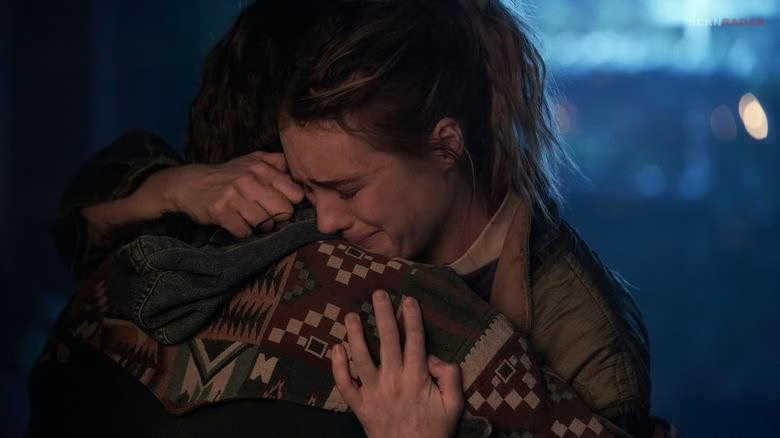
In the finale, Kirsten’s reunion with Jeevan becomes one of the most powerful moments in the series. After years of believing he was gone, she finally reconnects with him in a quiet, emotional scene that avoids melodrama. The reunion is not about dramatic revelation but about recognition and healing.
This moment represents the resolution of Kirsten’s internal conflict. Her journey was never just about survival but about finding a sense of belonging and emotional stability. The reunion with Jeevan completes that arc in a deeply human way.
Jeevan’s story comes full circle
Jeevan’s arc mirrors Kirsten’s in many ways, though his journey is shaped by different challenges. After being separated from Kirsten during the pandemic’s early days, Jeevan struggles with guilt and uncertainty about her fate.
The series later reveals that Jeevan eventually builds a new life as a healer and father. His transformation from an ordinary man into someone capable of helping others reflects one of the show’s central themes: growth through adversity.
When Jeevan finally reunites with Kirsten, the moment feels earned because of everything both characters have endured. Their relationship was never defined by blood or obligation but by shared survival and emotional connection.
The reunion also reinforces the idea that time does not erase meaningful relationships. Even after years apart, their bond remains intact, suggesting that human connection can survive even the most extreme circumstances.
Jeevan’s journey ultimately becomes one of redemption. His guilt over losing Kirsten is replaced by the relief of finding her again, completing his emotional arc.

The Prophet’s story redefines the show’s conflict
The Prophet initially appears to be the series’ main antagonist. His mysterious presence, combined with his control over a group of children, creates an aura of danger that builds tension throughout the story.
However, the finale reveals that The Prophet, whose real name is Tyler, is far more complex than a typical villain. His actions are deeply influenced by his childhood trauma and his interpretation of the Station Eleven graphic novel.
Tyler’s belief system is shaped by isolation and loss. After the pandemic, he grows up disconnected from stable emotional support, leading him to create his own narrative about the world. His use of the graphic novel as a guiding text reflects how stories can be interpreted in vastly different ways.
In the final confrontation, Kirsten reaches Tyler not through violence but through shared understanding. Both characters have used the same story to cope with trauma, but in different ways. This realization allows Kirsten to connect with him on a deeper level.
The resolution of Tyler’s storyline emphasizes empathy over conflict. Instead of being defeated, he is understood, which aligns with the show’s message about healing.
Clark and the airport community represent another form of survival
Clark’s storyline provides an important contrast to the Traveling Symphony. While Kirsten and her group embrace movement and artistic expression, Clark focuses on preserving the past within the airport community.
The airport becomes a symbol of memory and stability. Clark’s decision to maintain artifacts from the pre-pandemic world reflects a desire to hold onto what was lost. However, this approach also creates tension, as it risks preventing emotional growth.
In the finale, Clark begins to shift his perspective. The arrival of the Traveling Symphony and the confrontation with Tyler force him to reconsider how he views survival and community. Instead of controlling everything, he starts to accept change.

Clark’s arc highlights the idea that survival is not just about preserving the past but also about adapting to the present. His willingness to evolve mirrors the growth seen in other characters.
The airport ultimately becomes a place of connection rather than isolation, reinforcing the show’s emphasis on community.
The role of the Station Eleven graphic novel
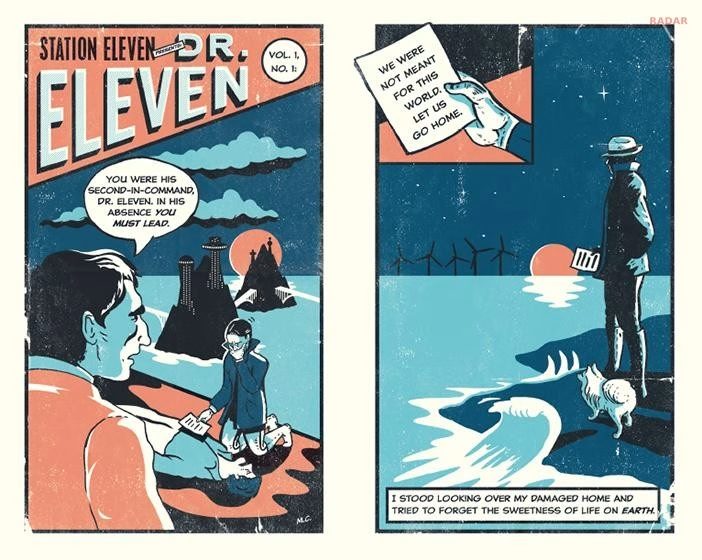
The Station Eleven graphic novel plays a central role in the series, serving as a symbolic link between multiple characters. Written by Miranda, the novel explores themes of isolation, identity, and survival within a fictional space narrative.
For Kirsten, the graphic novel represents comfort and continuity. It is a reminder of her childhood and a way to process her experiences. For Tyler, however, the novel becomes something more extreme, shaping his worldview and guiding his actions.
The finale highlights how the same story can have vastly different meanings depending on the reader. Kirsten uses the novel to heal, while Tyler initially uses it to justify his beliefs. Their interaction ultimately shows that stories are not fixed but can evolve over time.
Miranda’s creation becomes one of the show’s most powerful symbols. Even though she does not survive the pandemic, her work continues to influence the world and connect people across time.
This theme reinforces the idea that art can outlive its creator and shape future generations in unexpected ways.
Why the ending avoids a traditional climax
One of the most notable aspects of Station Eleven’s ending is its refusal to deliver a conventional climax. Instead of a large-scale battle or dramatic confrontation, the finale resolves its conflicts through conversation and emotional understanding.
This approach may feel unusual for viewers expecting a more action-driven conclusion. However, it aligns perfectly with the show’s thematic focus. Station Eleven has always been more interested in human relationships than external threats.
The lack of violence in the final resolution is intentional. It suggests that the real conflict was never about physical survival but about emotional healing. By choosing empathy over confrontation, the show reinforces its core message.
This narrative choice also sets Station Eleven apart from other post-apocalyptic stories. Rather than focusing on the collapse of civilization, it emphasizes what comes after and how people rebuild their lives.
The ending’s quiet tone allows the emotional moments to resonate more deeply, creating a lasting impact.
The meaning behind “survival is insufficient”
The phrase “survival is insufficient,” borrowed from Star Trek, serves as the central philosophy of Station Eleven. The finale fully explores this idea by showing that simply staying alive is not enough to create a meaningful life.
Through the Traveling Symphony, the show demonstrates how art, performance, and storytelling provide purpose beyond basic survival. The characters are not just living; they are expressing themselves and connecting with others.
Kirsten’s journey embodies this philosophy. Her survival is important, but it is her ability to perform, remember, and connect that gives her life meaning. The same applies to other characters who find purpose in rebuilding relationships and communities.
The finale reinforces that survival must be accompanied by emotional and cultural growth. Without these elements, life becomes empty, even in a post-apocalyptic world.

This message gives Station Eleven a uniquely hopeful perspective. Despite its setting, the show ultimately celebrates human resilience and creativity.
What the ending says about trauma and healing
At its core, Station Eleven is a story about trauma and how people cope with it. Each character represents a different response to loss, from Kirsten’s reliance on storytelling to Tyler’s creation of a belief system.
The finale brings these perspectives together, showing that healing is not a single process but a series of choices. Characters must confront their pasts and find ways to move forward without being consumed by them.
Kirsten’s ability to empathize with Tyler becomes a key moment in this theme. By recognizing their shared trauma, she helps him see the possibility of a different path. This interaction highlights the importance of understanding rather than judgment.
The show suggests that healing requires connection. Isolation, whether physical or emotional, prevents growth. By coming together, the characters are able to begin rebuilding not just society but their own identities.
This focus on healing gives the ending its emotional weight. It is not about resolving every conflict but about creating the possibility for a better future.