

Omniscient Reader’s Viewpoint has emerged as one of the most talked-about Korean web novels, gaining global popularity for its unique take on storytelling and character perspective. Written by Sing Shong, the series blends action, fantasy, and psychological drama into a layered narrative that constantly challenges reader expectations. At its core, the story explores what happens when a reader becomes part of the very story they once consumed.
Unlike traditional fantasy narratives that follow predictable hero arcs, Omniscient Reader’s Viewpoint thrives on its meta approach. It blurs the lines between reader and protagonist, fiction and reality, creating a narrative that feels both immersive and intellectually engaging. This concept alone sets it apart in a crowded genre filled with isekai and survival-based plots.
In this review, let’s break down what makes Omniscient Reader’s Viewpoint so impactful, from its storytelling structure and characters to its themes and execution.
A Unique Premise That Redefines Perspective
One of the biggest strengths of Omniscient Reader’s Viewpoint lies in its premise. The story follows Kim Dokja, an ordinary office worker who suddenly finds himself living inside the world of a web novel he has been reading for years. This novel, titled “Three Ways to Survive the Apocalypse,” becomes his reality, and his knowledge of future events turns into his greatest advantage.
What makes this concept stand out is how it uses the idea of perspective as a core narrative device. Kim Dokja is not the original protagonist, which creates an interesting dynamic where he must navigate a story that was never meant to revolve around him. This approach allows the narrative to constantly subvert expectations, as readers are aware that knowledge alone is not always enough to control outcomes.
The story also plays with the idea of storytelling itself. It questions who truly owns a narrative, the writer, the characters, or the reader. This layered storytelling adds depth and keeps readers engaged beyond surface-level action.
Complex Characters and Emotional Depth
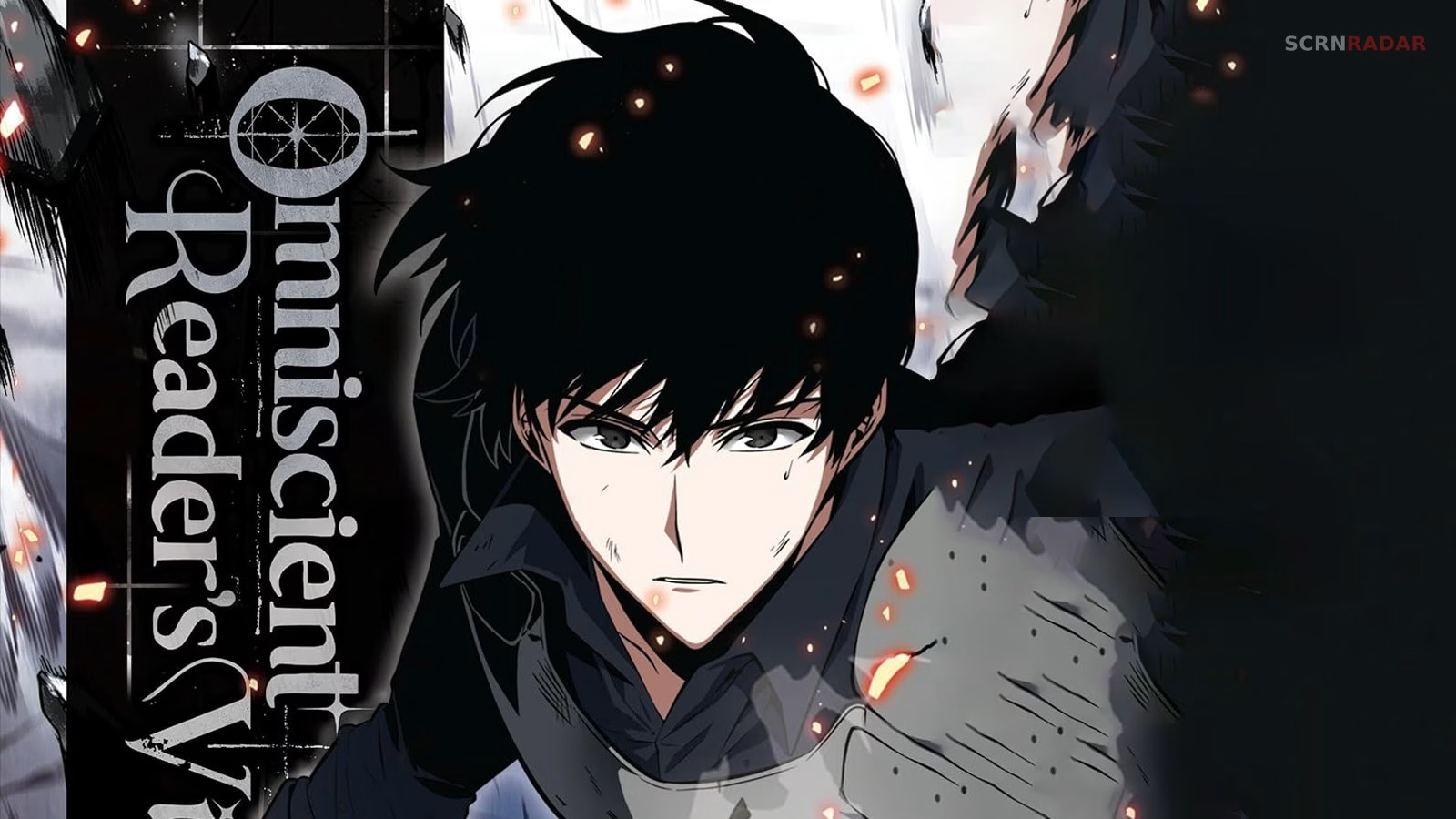
Beyond its premise, the novel excels in character development. Kim Dokja is a deeply layered protagonist who evolves significantly over time. While he initially relies on his knowledge of the story to survive, he gradually becomes more emotionally invested in the characters around him, blurring the line between observer and participant.
Another standout character is Yoo Joonghyuk, the original protagonist of the in-universe novel. His dynamic with Kim Dokja is central to the story, often shifting between rivalry, mistrust, and mutual understanding. This relationship adds emotional tension and drives many of the narrative’s most impactful moments.
The supporting cast is equally well-developed, each with their own motivations, backstories, and arcs. This attention to character depth ensures that the story never feels one-dimensional, even during its most action-heavy sequences.
Themes That Go Beyond Survival
While Omniscient Reader’s Viewpoint may appear to be a survival story on the surface, its themes run much deeper. The novel explores ideas such as fate versus free will, the nature of storytelling, and the role of the audience in shaping narratives. These themes are woven seamlessly into the plot, making the story both entertaining and thought-provoking.
One of the most compelling aspects is how the story examines the relationship between creators and consumers. Kim Dokja represents the reader, someone who has invested emotionally in a story, while the unfolding events challenge his understanding of that narrative. This creates a meta commentary on fandom, interpretation, and the emotional impact of fiction.
The story also look into human resilience and connection. Despite the harsh and often brutal world, moments of empathy and sacrifice stand out, giving the narrative a strong emotional core.
Storytelling Structure and Pacing
The structure of Omniscient Reader’s Viewpoint is another area where it excels. The narrative is divided into scenarios, each acting as a self-contained arc while contributing to the overarching story. This episodic format keeps the pacing dynamic and allows for a variety of challenges and settings.
At the same time, the story maintains a strong sense of progression. Each scenario builds on the previous one, gradually expanding the world and raising the stakes. This balance between episodic storytelling and long-term narrative development is one of the reasons the series remains engaging throughout its run.
The pacing can occasionally feel dense, especially during exposition-heavy sections, but this is often necessary given the complexity of the world-building. Overall, the structure supports the story’s ambitious scope without losing coherence.