Few psychological thrillers frustrate and fascinate audiences in equal measure like Spinning Man. On paper, it’s a straightforward mystery about a missing student and a suspicious professor. In execution, it becomes something far more complex. A film that constantly questions truth, memory, and perception.
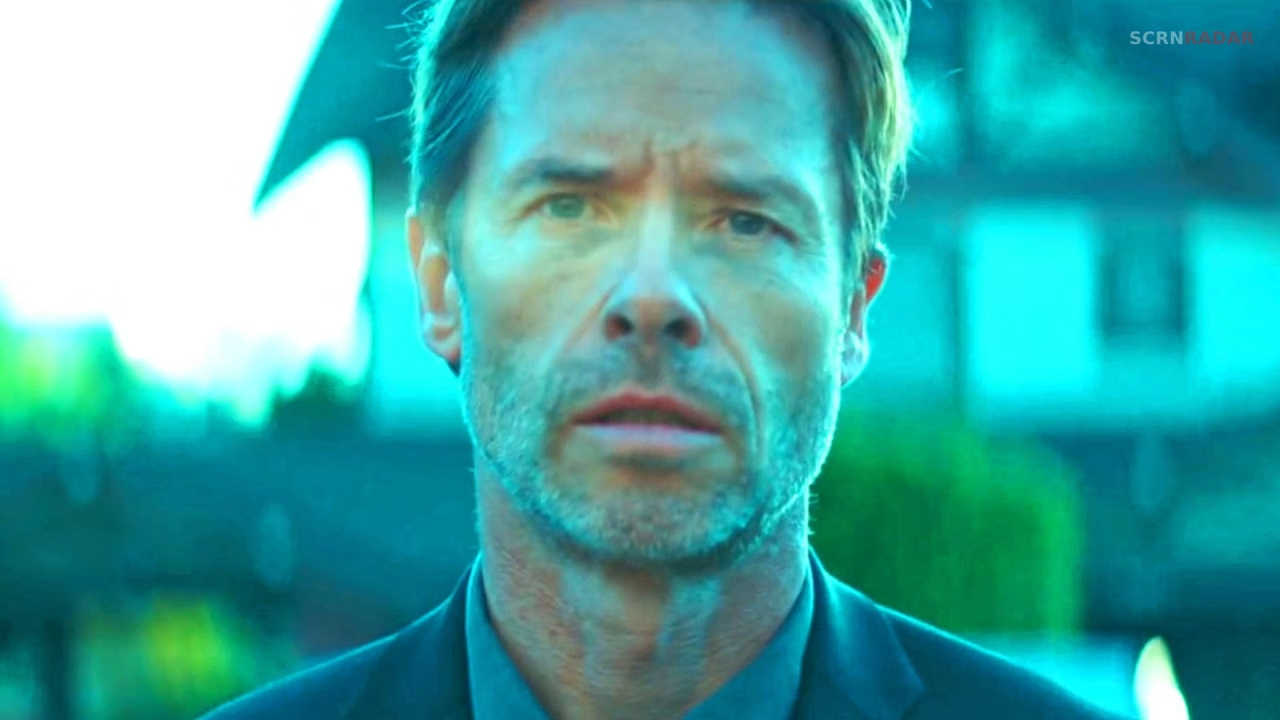
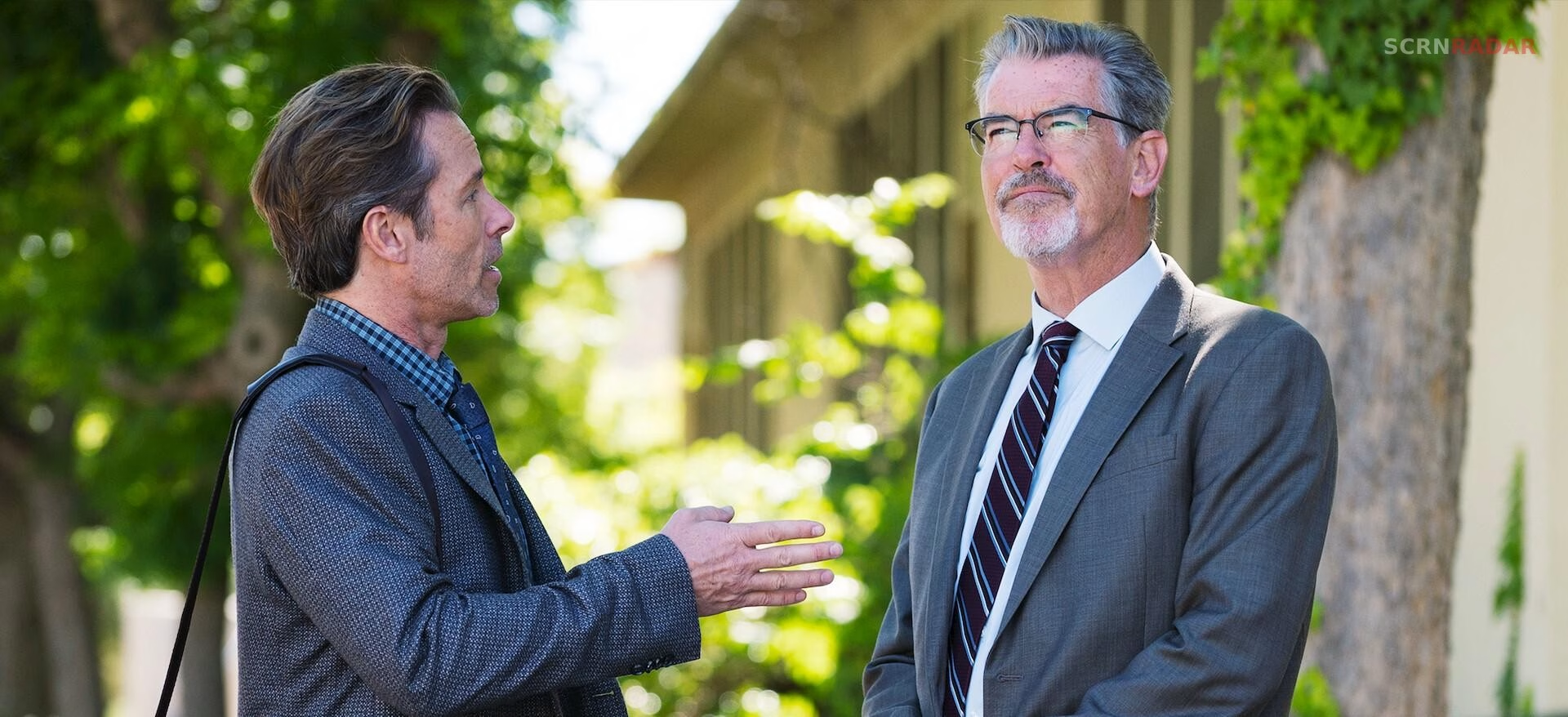
Starring Guy Pearce as philosophy professor Evan Birch and Pierce Brosnan as Detective Malloy, the film blends crime investigation with philosophical uncertainty. As evidence mounts, Evan becomes the prime suspect in the disappearance of a young woman, yet he himself is unsure of what really happened.
By the time the film reaches its ending, it refuses to give a clear answer. Instead, it hands that responsibility to the audience. But one scene changes how that ambiguity should be interpreted. The confession.
Let’s break down what actually happens, what it means, and whether the truth is hidden in plain sight.
The Setup: A Mystery Built on Uncertainty
At its core, Spinning Man follows a classic thriller structure. A young woman named Joyce disappears, and circumstantial evidence begins pointing toward Evan Birch. He has a questionable past, including inappropriate relationships with students, and his alibi contains gaps.
What makes the story unique is Evan himself. He is not a typical unreliable narrator. Instead, he is someone who genuinely does not trust his own memory. Throughout the film, he experiences fragmented recollections, fantasies, and blurred timelines.
This creates a central tension. Not just whether Evan is guilty, but whether he even knows if he is guilty.
Detective Malloy represents the opposite perspective. He relies on evidence, logic, and observable facts. This clash between philosophical doubt and investigative certainty becomes the film’s driving force.
From the beginning, Spinning Man sets up a world where truth is not easily defined.
The Ambiguous Ending: Did Evan Do It?
The ending of Spinning Man is deliberately unclear. After a series of increasingly disorienting events, Evan walks into Malloy’s office and confesses to the crime.
He claims that he had an affair with Joyce, accidentally killed her, and disposed of her body. On the surface, this seems like a resolution.
But the film immediately undercuts it.
Malloy rejects the confession. He points out that the physical evidence does not match Evan’s story. Joyce’s injuries suggest she fell from a cliff, not that she was killed in the way Evan describes.
This contradiction leaves the audience with two possibilities. Either Evan is lying, or he genuinely believes something that is not true.
The film does not resolve this tension. Instead, it ends on that uncertainty, forcing viewers to decide what they believe.
The Confession Scene: The Key to Everything
The confession scene is the most important moment in the entire film, and it fundamentally changes how the ending should be interpreted.
Evan does not confess because he is caught. He confesses because he believes he might be guilty. This distinction is crucial.
Throughout the film, his sense of reality has been eroding. He imagines scenarios, recalls events differently, and begins to internalize the suspicion surrounding him. By the time he reaches Malloy’s office, he is no longer certain of his own innocence.

This aligns with a psychological concept often discussed in relation to the film. Memory distrust syndrome. A condition where individuals lose confidence in their memories and become susceptible to false beliefs.
In this context, Evan’s confession is not a revelation of truth. It is a symptom of psychological collapse.
The confession scene reframes the entire narrative. Instead of asking whether Evan committed the crime, it asks whether truth itself can be trusted when memory is unreliable.
Evidence vs. Perception: Why Malloy Rejects the Confession
One of the most overlooked aspects of the ending is Detective Malloy’s response. In many thrillers, a confession is the final piece of the puzzle. Here, it is dismissed.
Malloy represents empirical truth. He relies on evidence, not interpretation. When Evan confesses, Malloy does not accept it because it contradicts the physical facts of the case.
According to the evidence, Joyce likely fell from a cliff and died from the impact. There is no indication of the scenario Evan describes.
This creates a powerful contrast. Evan’s version of events is emotionally convincing but factually unsupported. Malloy’s version is logically sound but lacks emotional closure.
The film ultimately sides with neither perspective. Instead, it highlights the gap between them.
This is why the ending feels unresolved. It is not about solving the mystery. It is about exposing the limits of certainty.
Themes Behind the Ending: Philosophy in Action
Spinning Man is not just a thriller. It is a philosophical exploration disguised as one.
Evan’s profession as a philosophy professor is central to the story. Throughout the film, he discusses ideas about truth, knowledge, and perception. These concepts are not just background elements. They are the foundation of the narrative.
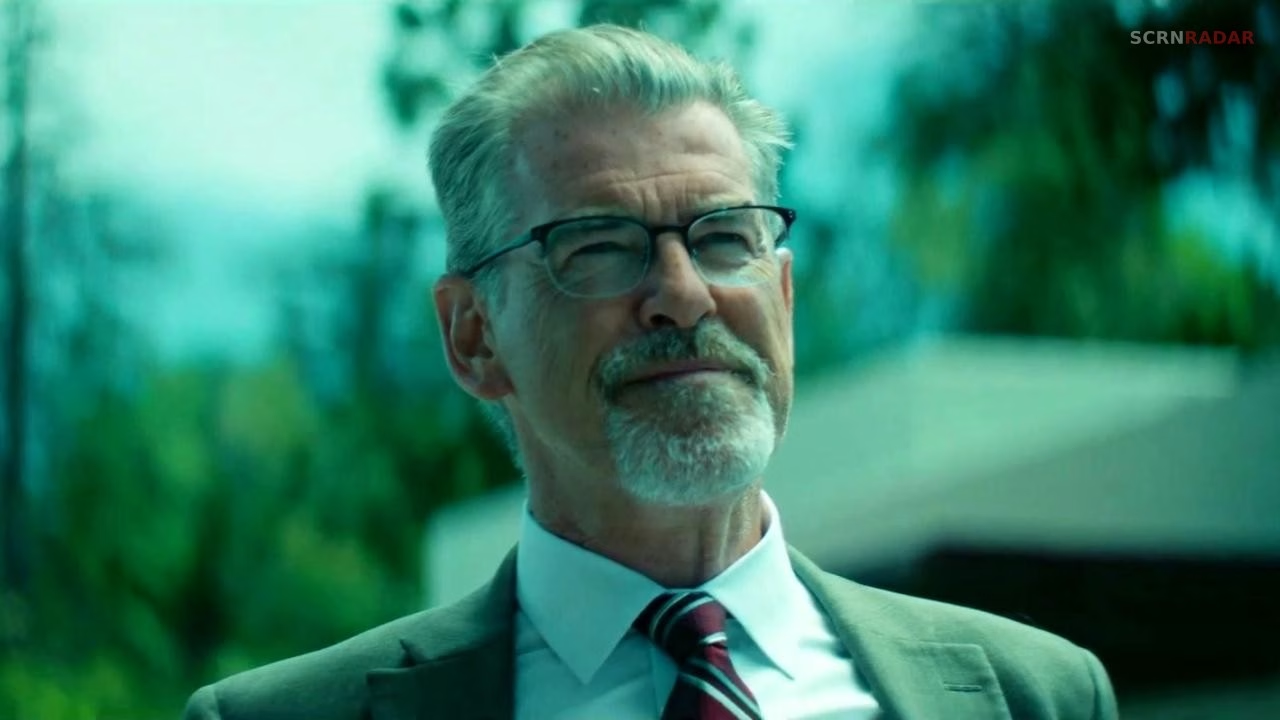
The ending embodies these themes. It presents multiple interpretations and refuses to confirm any of them.
One key idea is that truth may not be objective. It may depend on perception, belief, and context. Evan believes he could be guilty, and that belief becomes his reality.
At the same time, the film questions whether objective truth exists at all. If memory can be unreliable and evidence can be interpreted in different ways, how can we ever be certain?
This philosophical ambiguity is what sets Spinning Man apart from more conventional thrillers.
Why the Ending Divides Audiences
The ambiguous ending of Spinning Man has been one of its most debated aspects. Some viewers appreciate the open-ended approach, while others find it unsatisfying.
Critics have noted that the film builds toward a resolution but ultimately avoids providing one, which can feel like a lack of payoff.
On platforms like Reddit, audience reactions often highlight confusion and frustration with the lack of clarity.
“I couldn’t even figure out the ending… I was confused.”
At the same time, others argue that this ambiguity is intentional and meaningful. The film is not trying to solve the mystery. It is trying to challenge how we think about truth.
This divide reflects the film’s core idea. Different people interpret the same information in different ways.
What Actually Happened? The Most Likely Explanation
While the film leaves the answer open, there are clues that suggest a likely explanation.
Based on the evidence presented, Joyce probably died from an accidental fall. This aligns with Malloy’s conclusion and the physical details of the case.
Evan’s involvement appears to be psychological rather than physical. His guilt stems from his past behavior, including inappropriate relationships and moral ambiguity.
These factors make him susceptible to believing he is capable of the crime, even if he did not commit it.
In this interpretation, the confession is not a revelation of guilt. It is an expression of internal conflict.
The truth, then, is less about what happened to Joyce and more about what is happening inside Evan’s mind.