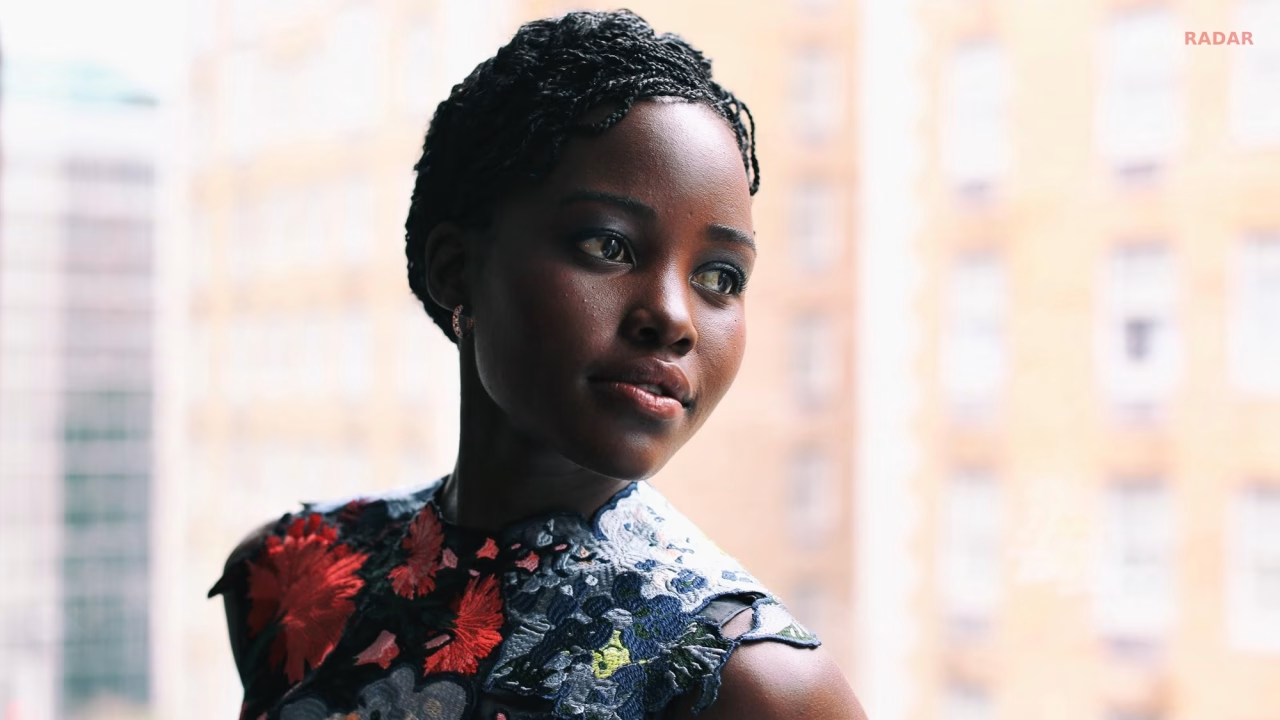
Lupita Nyong’o is speaking out following online criticism surrounding her casting as Helen of Troy in Christopher Nolan’s upcoming film The Odyssey. The backlash, which gained traction across social media and political commentary spaces, questioned the casting choice, but Nyong’o has now directly addressed those concerns in a recent interview.
In a profile with Elle, the Oscar-winning actor made it clear that her focus remains on the story and creative vision rather than responding to every criticism. Her comments highlight a broader conversation about representation, adaptation, and how audiences interpret classic narratives in modern cinema.
Nyong’o Emphasizes Myth Over Historical Accuracy
One of the key points Nyong’o raised in response to the criticism is the nature of The Odyssey itself. She stressed that the story is rooted in mythology rather than strict historical reality, challenging the premise behind some of the backlash.
“this is a mythological story,”
she said, reframing the conversation around the film’s creative intent rather than literal interpretation. By doing so, Nyong’o positioned Nolan’s adaptation as part of a long tradition of retelling and reimagining ancient stories for contemporary audiences.
She also expressed support for Nolan’s vision, stating,
“I’m very supportive of Chris’s intention with it and with the version of this story that he is telling.”
Her comments suggest that the casting choices reflect a broader, more inclusive approach to storytelling rather than adherence to conventional expectations.
Addressing Criticism Without Engaging in It
The backlash gained wider attention after comments from figures like Elon Musk, who responded to online criticism of the casting. However, Nyong’o made it clear that she does not intend to center her energy on responding to detractors.
“I’m not spending my time thinking of a defense,”
she said in the same Elle interview.
“The criticism will exist whether I engage with it or not.”
This approach reflects a deliberate choice to focus on her work rather than the surrounding noise, a stance that has resonated with many in the industry.
Nyong’o also added,
“I can’t spend my time thinking about all the people who still don’t love me… You’ll find the representatives who believe in you, and you’ll get on with it.”
The statement underscores her perspective on steering public scrutiny while maintaining confidence in her craft.
Moving Beyond the Idea of “Beauty”
Another major point in Nyong’o’s response was her rejection of the traditional framing of Helen of Troy as simply “the most beautiful woman in the world.” Instead, she emphasized the importance of character depth over surface-level attributes.
“You can’t perform beauty,”
she explained.
“I want to know who a character is. What is beyond beauty? What is beyond looks?”
This perspective aligns with a broader shift in modern filmmaking, where iconic characters are increasingly explored through more complex and layered interpretations.
By focusing on character rather than appearance, Nyong’o is signaling a different approach to portraying Helen of Troy, one that prioritizes narrative substance over traditional labels.
A Modern Take on a Classic Epic
Nolan’s The Odyssey is expected to be a large-scale adaptation of Homer’s epic, a story that has been interpreted in countless ways over centuries. Each version reflects the cultural context of its time, and this latest adaptation appears to be no exception.
Nyong’o described the project as part of a larger storytelling evolution, noting, “We’re occupying the epic narrative of our time.” Her comment suggests that the film aims to resonate with contemporary audiences while still drawing from its ancient roots.
She also expressed gratitude for the opportunity, saying she was “deeply honored to be entrusted with the role.” This highlights her commitment to bringing a fresh perspective to one of literature’s most iconic figures.