The raw, emotional show of American Rust feels deeply rooted in realism, from its struggling working-class characters to its haunting industrial landscapes. Set in the fictional town of Buell, Pennsylvania, the series explores the decline of the American Dream through the lens of a murder investigation and the lives it disrupts. But while Buell plays a central role in the story, he does not actually exist.
Instead, the show brings this fictional town to life using real locations across Pennsylvania, primarily in and around Pittsburgh. Featuring performances from Jeff Daniels and Maura Tierney, the series uses authentic environments to capture the essence of Rust Belt America. Let’s break down where American Rust was filmed, how these locations shape the story, and why Pennsylvania was the perfect choice for this powerful drama.
The Fictional Town of Buell and Its Real-Life Inspiration
At the heart of American Rust lies Buell, a fictional town set in Fayette County, Pennsylvania. While the location itself is made up, it reflects the real struggles of communities across the Rust Belt, a region historically defined by steel production and industrial growth.
The Rust Belt spans parts of the northeastern and midwestern United States, including Pennsylvania, Ohio, and Michigan. Once thriving with factory jobs and economic stability, many towns in this region faced decline after industries shut down. Buell is a symbolic representation of these places, embodying themes of unemployment, economic hardship, and fading hope.
The show’s narrative, based on the novel by Philipp Meyer, captures the emotional and social impact of this decline. Rather than relying on sets alone, the creators chose real Pennsylvania locations to give the story authenticity and depth.
Most of American Rust was filmed in and around Pittsburgh, which serves as the backbone of the production. Known for its industrial history and steel manufacturing legacy, Pittsburgh provides the perfect visual tone for the series.
A significant portion of the show was filmed at 31st Street Studios, located at 77 31st Street. This facility served as the main production hub, housing multiple soundstages used for interior scenes.
The studio allowed the crew to build controlled environments for key locations such as police stations, homes, and offices. With at least eight soundstages, it provided the flexibility needed for a complex narrative with multiple characters and settings.
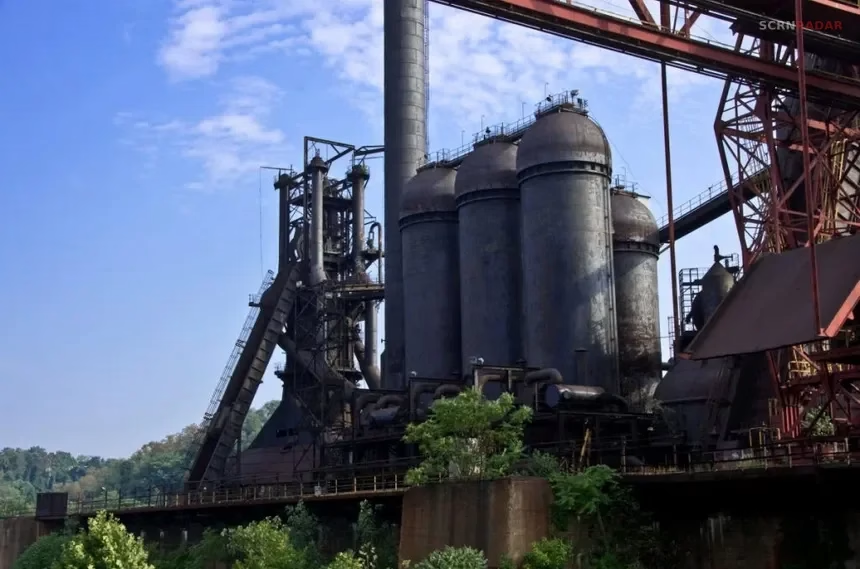
One of the most visually striking filming locations is Carrie Blast Furnaces. Once part of the Homestead Steel Works, this site is now a preserved industrial landmark that perfectly reflects the Rust Belt’s past.
Scenes filmed here capture the decaying infrastructure and abandoned factories that define the show’s atmosphere. The location plays a crucial role in establishing the tone of American Rust, making the environment feel like a character in its own right.
The furnaces also appear in pivotal scenes involving key characters, reinforcing the themes of decay and lost opportunity that run throughout the series.
Another important filming location is the backlot at 1310 Beulah Road, located just outside Pittsburgh. This site was used to construct exterior sets, including the homes of central characters like Del Harris and Grace Poe.
By building these sets in a controlled environment, the production team ensured consistency while still maintaining a realistic look. The rural surroundings of the area helped replicate the small-town feel of Buell.
Expanding Beyond Pittsburgh: Western Pennsylvania Locations
While Pittsburgh serves as the main hub, the production also utilized various locations across Western Pennsylvania to bring Buell to life.
The borough of Monroeville played a key role in filming, with several scenes shot in and around the area. Its suburban landscapes provided a contrast to Pittsburgh’s industrial backdrop.
Other parts of Allegheny County, including towns like Clairton, Braddock, and Glassport, were also used. These locations added variety while maintaining the gritty, working-class aesthetic central to the series.
Additional Pennsylvania Locations
To fully capture the Rust Belt environment, the crew filmed in multiple towns across the state. Areas such as Donora, Ambridge, and Belle Vernon contributed to the show’s authentic setting.
These locations were carefully chosen for their resemblance to the fictional Buell. Their aging infrastructure, quiet streets, and industrial remnants helped create a believable and immersive world.
Filming entirely in Pennsylvania was not just a logistical decision but a creative one. The state’s real-life landscapes closely mirror the themes explored in American Rust.
Pittsburgh and its surrounding areas offer a unique blend of urban and rural environments. From abandoned steel mills to small-town neighborhoods, the region provides everything needed to depict the struggles of the Rust Belt.
According to Jeff Daniels, the location itself is as important as the characters. The authenticity of the setting adds emotional weight to the story, making it more relatable and impactful.
Tax incentives also played a role in the decision. Pennsylvania offers film tax credits that make it an attractive destination for productions, allowing filmmakers to maximize their budgets while maintaining high production quality.
The locations in American Rust are not just backdrops but integral parts of the narrative. The crumbling factories, quiet neighborhoods, and industrial landscapes reflect the internal struggles of the characters.
For example, scenes set at the Carrie Blast Furnaces emphasize the decline of industry and its impact on the community. Similarly, the small-town settings highlight the isolation and limited opportunities faced by residents.
The use of real locations also helps ground the story in reality. Viewers can sense that these places exist, which adds to the emotional authenticity of the series.
Production Timeline and Filming Details
Filming for the first season of American Rust began in March 2021 after delays caused by the COVID-19 pandemic. Production wrapped up in August 2021, with most scenes shot over several months across Pennsylvania.
For Season 2, subtitled Broken Justice, the cast and crew returned to Pennsylvania, continuing to use Pittsburgh and its surrounding areas. This consistency helped maintain the visual identity of the series.
The production process involved combining on-location shooting with studio work at 31st Street Studios. This approach allowed the team to balance realism with efficiency.
American Rust succeeds in creating a believable and emotionally powerful world by grounding its story in real locations. While Buell may be fictional, the places used to represent it are very real and deeply connected to the themes of the series.
From the industrial ruins of Carrie Blast Furnaces to the streets of Pittsburgh, every location contributes to the show’s authenticity. The decision to film in Pennsylvania ensures that the story feels genuine, reflecting the real struggles of communities across the Rust Belt.
For viewers, this attention to detail makes American Rust more than just a crime drama. It becomes a portrait of a region, its people, and the challenges they face. And for those interested in filming locations, the series offers a compelling look at how real-world settings can bring fictional stories to life in a powerful and meaningful way.