Noir Korean dramas have become a major force in global streaming, especially for viewers seeking dark thrillers that go beyond surface-level crime stories. These shows focus on morally complex characters, layered investigations, and tension that builds gradually rather than relying on constant action.
What separates the best noir K-dramas from standard thrillers is their emphasis on consequence. Every decision matters, every secret has weight, and every reveal reshapes the story. Instead of clear heroes and villains, these dramas operate in shades of grey, where truth is often fragmented, and justice is rarely clean.
This list highlights five standout series that fully embrace noir storytelling, offering tightly written plots, strong performances, and narratives that remain engaging from start to finish.
1. BEYOND EVIL – A SHIFTING INVESTIGATION BUILT ON SUSPICION
Beyond Evil begins as a small-town serial murder case but quickly transforms into a layered psychological investigation where the line between investigator and suspect constantly blurs.
The story revolves around two detectives with opposing methods. One is deeply embedded in the town with a questionable past, while the other arrives with a clear goal but limited trust in those around him. Their partnership is built on suspicion rather than cooperation, which becomes the driving force of the narrative.
Each episode recontextualizes earlier events. Evidence introduced early takes on new meaning as more information is revealed, creating a structure that encourages viewers to reassess everything they’ve seen. The show avoids straightforward answers, instead presenting multiple possibilities before narrowing in on the truth.
The pacing is deliberate, focusing on interrogation scenes, subtle behavioral cues, and emotional reactions rather than action sequences. This allows tension to build naturally, especially during moments where silence or hesitation reveals more than dialogue.
As the investigation expands, it exposes past crimes and systemic failures within the town, tying individual actions to a larger history. The final resolution connects these elements cohesively, making the narrative feel complete without relying on last-minute twists.
2. MY NAME – DUAL IDENTITY WITHIN CRIME AND LAW ENFORCEMENT
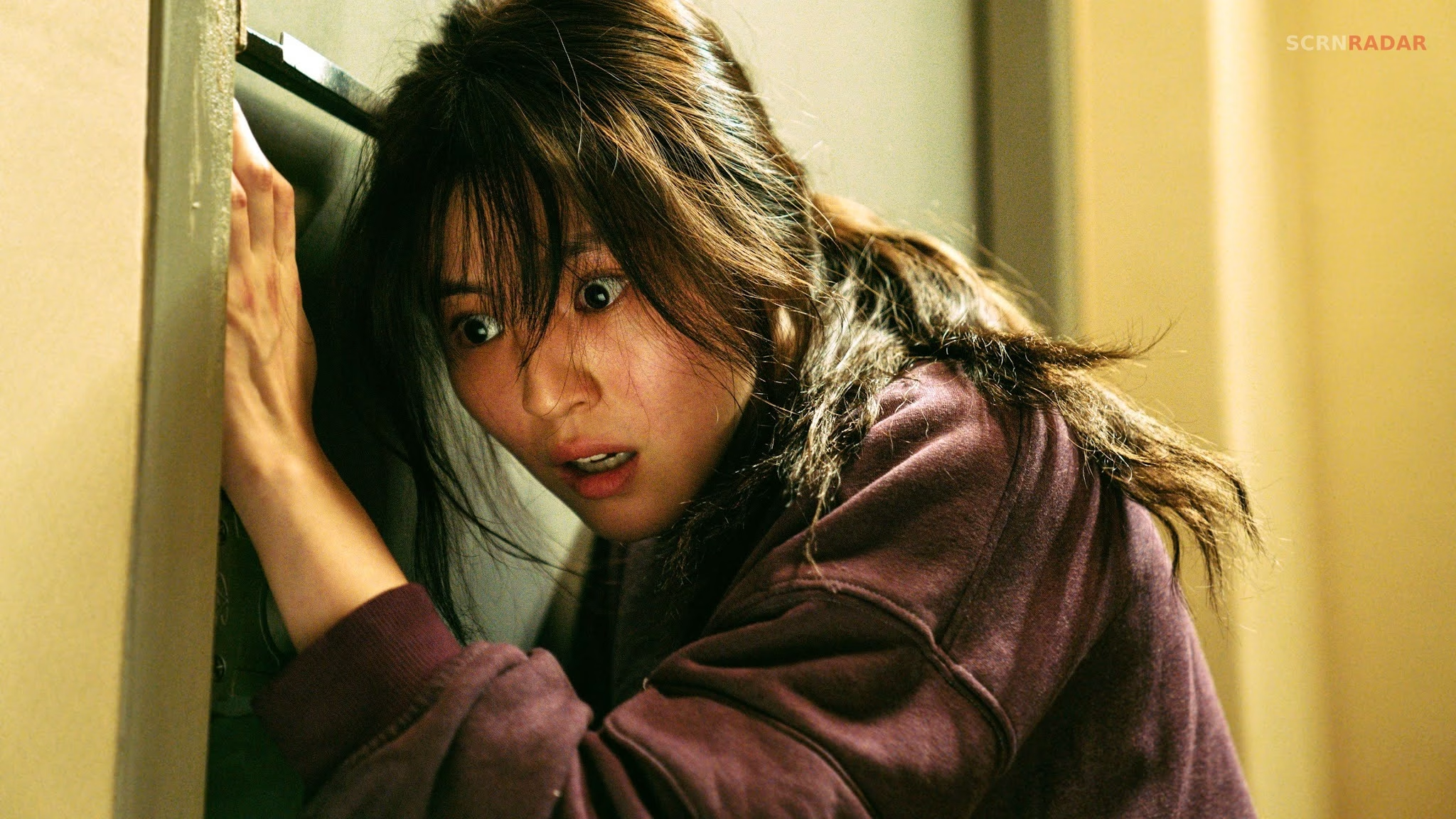
My Name is structured around a revenge narrative but gains depth through its use of dual identity. The protagonist operates simultaneously within a criminal organization and the police force, creating constant internal and external conflict.
The series establishes its stakes early. After witnessing her father’s murder, the lead character commits fully to uncovering the truth, even if it means aligning herself with dangerous individuals. Her transformation is gradual, moving from vulnerability to calculated control.
The tension is sustained through proximity. As she integrates deeper into the police system, her risk of exposure increases, especially when forming relationships with colleagues who remain unaware of her true identity. These interactions create layered conflicts where emotional trust and hidden agendas coexist.
Action sequences are frequent but grounded. Fight choreography emphasizes realism, with physical consequences that affect later episodes. Injuries, fatigue, and psychological strain carry over, reinforcing continuity within the story.
Narratively, the show progresses with a clear structure. Each episode reveals new information about her father’s death while simultaneously complicating her position within both worlds. Betrayals are introduced gradually, ensuring that major turning points feel justified rather than abrupt.
3. STRANGER – INTERCONNECTED CASES WITHIN A CORRUPT SYSTEM
Stranger focuses less on individual crimes and more on how those crimes are shaped by institutional power. The central narrative begins with a murder but expands into a broader investigation involving prosecutors, police, and corporate influence.
The protagonist approaches cases through logic rather than emotion, which affects how information is processed and decisions are made. This contrasts with his partner, whose approach is more intuitive and empathetic. Their dynamic influences the direction of the investigation, often leading to different interpretations of the same evidence.
The structure is highly interconnected. Events are not isolated; each development ties into a larger network of corruption. Early clues often seem minor but become significant as the story unfolds, requiring attention to detail from the viewer.
Dialogue is the primary tool for progression. Conversations reveal motives, alliances, and hidden agendas, often carrying more weight than physical evidence. This creates a dense narrative where information is layered rather than immediately explained.
The pacing remains consistent throughout, avoiding unnecessary subplots. Instead, the show builds tension through gradual escalation, where each discovery leads to a more complex situation rather than a resolution.
4. FLOWER OF EVIL – CONCEALED IDENTITY WITHIN A DOMESTIC SETTING

Flower of Evil combines noir elements with a character-focused narrative built around secrecy and proximity. The central character maintains a fabricated identity while living with his detective wife, creating a situation where the investigation unfolds within his personal life.
The story uses dual timelines to structure its reveals. Present-day events are intercut with fragments of the past, gradually exposing the truth behind the protagonist’s identity. This approach ensures that information is released in stages rather than all at once.
The tension is driven by overlap. As the detective investigates a case connected to her husband’s past, each new discovery reduces the distance between suspicion and confirmation. This creates sustained pressure, especially in scenes where both characters share information unknowingly.
Character interactions are central to the narrative. Dialogue between the leads carries multiple layers, where statements can be interpreted differently depending on what each character knows at the time.
The series balances emotional development with plot progression. Relationship dynamics evolve alongside the investigation, ensuring that personal stakes remain as significant as the central mystery.
5. THE KING OF PIGS – NONLINEAR STORYTELLING ROOTED IN TRAUMA
The King of Pigs uses a nonlinear narrative to connect past trauma with present-day actions. The story alternates between a current murder investigation and flashbacks to school violence experienced by the main characters.
The structure is designed to reveal cause and effect gradually. Present events introduce questions, while past sequences provide context, allowing the audience to understand motivations without immediate explanation.
The investigation itself is closely tied to personal history. Detectives uncover connections between victims and perpetrators that trace back years, linking current crimes to unresolved emotional and psychological damage.
The tone remains consistently dark, with minimal relief. Scenes are constructed to emphasize discomfort and tension, particularly during flashbacks that depict formative experiences.
Character development is driven by memory and consequence. Actions in the present are directly influenced by past events, creating a narrative where every reveal adds depth rather than simply advancing the plot.
The pacing is steady, with each episode contributing new information that reshapes understanding of both timelines. Instead of relying on sudden twists, the show builds toward its conclusions through accumulation, making the final outcomes feel inevitable rather than surprising.