Few teen dramas have remained as emotionally unsettling and culturally discussed as Thirteen. Directed by Catherine Hardwicke and co-written by Nikki Reed, the 2003 film surprised audiences with its raw portrayal of adolescence, peer pressure, self-harm, substance abuse, and fractured family relationships. More than twenty years later, viewers are still searching for explanations about the movie’s final scenes and what happens to Tracy after everything falls apart.
The ending of Thirteen does not provide a clean resolution. Instead, it leaves viewers sitting with emotional discomfort, much like Tracy herself. By the end of the film, Tracy has lost her identity, her friendships, her academic future, and nearly her relationship with her mother. Yet the final moments also suggest that she may finally be confronting the truth about herself for the first time. The movie’s ending works because it avoids easy answers and focuses on emotional realism rather than dramatic redemption.
What happens at the end of Thirteen?
By the final act of Thirteen, Tracy Freeland’s life has spiraled completely out of control. What began as a desperate attempt to fit in with the popular crowd slowly transformed into destructive behavior fueled by insecurity, rebellion, and emotional instability. Tracy’s friendship with Evie leads her into shoplifting, drug use, sexual experimentation, violence, and self-harm, while her school performance and family relationships collapse around her.
The climax occurs when Evie’s guardian Brooke confronts Tracy at her home. Evie manipulates the situation by framing Tracy as the bad influence, even though the film clearly shows that both girls pushed each other deeper into destructive behavior. Brooke decides to move Evie away from Tracy entirely, believing separation is the only solution. Tracy tries to defend herself, but the situation becomes even more devastating when Brooke exposes Tracy’s self-harm scars in front of everyone.
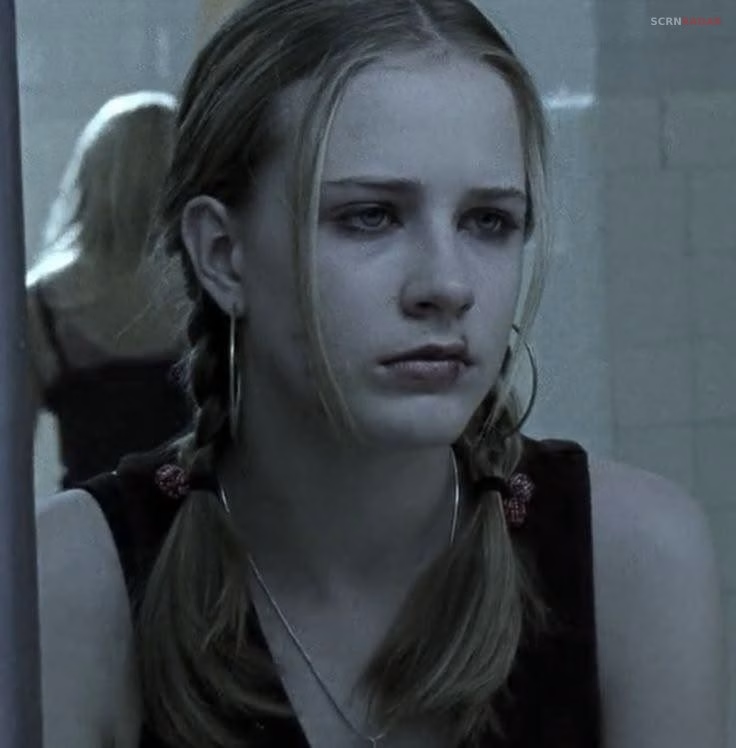
This moment destroys the final emotional barrier Tracy had been hiding behind. Throughout the film, Tracy masks her vulnerability with aggression and reckless behavior, but once her scars are revealed, she can no longer pretend everything is under control. Her emotional collapse afterward is one of the most painful scenes in the movie because it strips away all the fake confidence she built around herself.
After Evie and Brooke leave, Tracy breaks down completely while her mother Melanie desperately tries to comfort her. Tracy initially fights against her mother’s embrace, screaming and resisting physical affection. However, Melanie refuses to let her go. Eventually, the two fall asleep together on Tracy’s bed, exhausted emotionally and physically.
The final image of the film shows Tracy alone on a merry-go-round, spinning while screaming into the air. That final visual is symbolic rather than literal, and it carries the emotional meaning of the entire movie.
What the merry-go-round ending really means
The merry-go-round scene is one of the most discussed parts of Thirteen because it leaves Tracy’s emotional state open to interpretation. On the surface, the scene appears chaotic and unresolved. Tracy spins in circles while screaming, suggesting emotional overload and psychological exhaustion. However, the symbolism behind the moment reveals something deeper about her character’s journey.
Throughout the film, Tracy constantly chases transformation. She wants to become older, cooler, more attractive, and more accepted. She believes popularity and rebellion will give her control over her life. Instead, every reckless decision only pushes her further away from herself. By the end, the spinning merry-go-round represents the emotional cycle she has been trapped inside for the entire story. She keeps moving rapidly, but she is ultimately going nowhere.
The scene also reflects the confusion of adolescence itself. Tracy is suspended between childhood and adulthood. The merry-go-round is a childlike object, but Tracy’s emotional breakdown on it feels terrifyingly adult. The contrast highlights the film’s central idea that Tracy is still fundamentally a child despite trying to force herself into adulthood too quickly.
Some viewers interpret the ending pessimistically, believing Tracy is too damaged to recover. Others see it as the beginning of emotional honesty because Tracy finally stops pretending to be someone else. The film intentionally leaves both interpretations possible. Rather than offering a neat recovery arc, the ending suggests that healing is uncertain, messy, and slow.

Does Tracy actually change by the end?
One of the biggest questions viewers ask after watching Thirteen is whether Tracy truly learns anything from her experiences. The answer is complicated because the film avoids dramatic moral lessons. Tracy does not suddenly become responsible or emotionally healthy by the final scene. However, there are important signs that she has finally recognized the consequences of her actions.
Earlier in the film, Tracy constantly rejects accountability. She blames her mother, ignores school, pushes away old friends, and fully embraces Evie’s destructive influence. Even when situations become dangerous, she continues chasing validation through rebellion. By the ending, though, the illusion surrounding Evie has collapsed completely.
When Evie abandons Tracy and turns the social group against her, Tracy realizes their friendship was never emotionally stable. Evie represented freedom and popularity, but she also represented manipulation and emotional instability. Tracy spent most of the film trying to become like Evie, only to discover that Evie herself is deeply damaged and emotionally lost.
The emotional breakdown at the end matters because Tracy finally allows herself to be vulnerable again. Her acceptance of Melanie’s comfort is subtle but significant. Earlier in the movie, Tracy treated her mother with cruelty and resentment. In the ending, she stops fighting completely. That does not solve her problems, but it suggests that the mother-daughter relationship still has a chance to survive.
Several critics and viewers have interpreted the ending as a fragile step toward recovery rather than a complete transformation. The movie understands that trauma and self-destruction cannot be fixed overnight, especially for someone as young as Tracy.
The real meaning behind Evie and Tracy’s friendship
At its core, Thirteen is less about drugs or teenage rebellion and more about identity. Tracy’s friendship with Evie becomes dangerous because Evie offers Tracy an entirely new version of herself. For a lonely thirteen-year-old struggling with insecurity and emotional instability, that transformation feels intoxicating.
Evie is charismatic, confident, rebellious, and socially powerful. Tracy becomes obsessed with earning her approval because she sees Evie as everything she wants to become. Yet the friendship is built on performance rather than genuine emotional support. Both girls encourage each other’s worst impulses because they are searching for escape rather than connection.
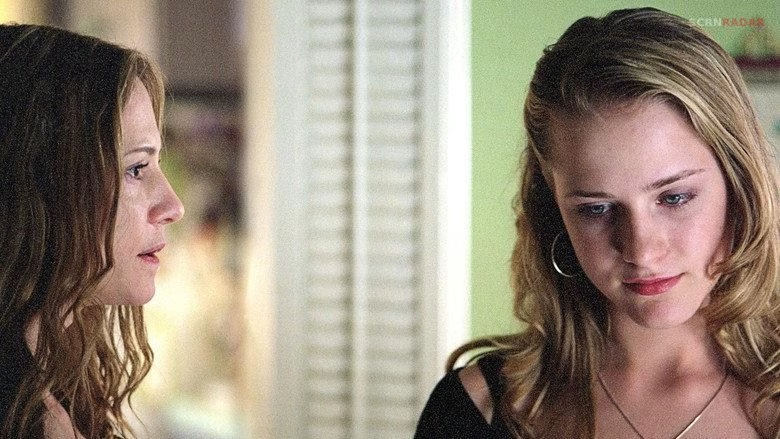
The film carefully shows how Tracy slowly abandons every part of her original identity. Her clothes change, her speech changes, her behavior changes, and even her emotional responses become performative. She is not simply rebelling against her mother. She is trying to erase herself entirely.
What makes the story tragic is that Evie is going through the same crisis. Despite appearing confident, Evie’s home life is chaotic and emotionally neglectful. Her request for Melanie to adopt her becomes one of the film’s saddest moments because it reveals how desperate she is for stability and affection.
By the end, both girls are emotionally broken in different ways. Tracy loses herself trying to become Evie, while Evie survives by constantly reinventing herself emotionally depending on the situation. Their friendship becomes a cycle of mutual self-destruction disguised as empowerment.
Why Thirteen still feels disturbing today
Even decades after its release, Thirteen remains difficult to watch because of how realistically it captures emotional instability during adolescence. Many teen dramas exaggerate rebellion for entertainment value, but Thirteen feels painfully intimate and grounded. The film does not romanticize Tracy’s behavior even when it occasionally shows why rebellion can feel emotionally liberating to teenagers.
Part of the movie’s impact comes from its autobiographical roots. Nikki Reed co-wrote the screenplay based partly on her own experiences as a young teenager, which gives the dialogue and emotional conflicts an uncomfortable authenticity. The film’s handheld camerawork, chaotic pacing, and emotionally raw performances further enhance that realism.
The movie also refuses to simplify parental relationships. Melanie is flawed, overwhelmed, and sometimes emotionally unavailable, but she genuinely loves Tracy. The film avoids turning her into either a villain or a perfect parent. Instead, it presents adolescence as a collision between vulnerable children and adults who are often struggling themselves.
Critics at the time described the movie as stunning and emotionally intense, while many modern viewers still debate whether the film serves as a cautionary tale or simply an honest portrayal of adolescence. That tension is part of why the film continues generating discussion years later.

Is the ending hopeful or tragic?
The ending of Thirteen is intentionally balanced between hope and tragedy. Tracy’s future remains uncertain, and the movie never pretends that emotional wounds disappear easily. She still faces damaged relationships, academic consequences, mental health struggles, and unresolved trauma.
At the same time, the ending avoids complete despair. Melanie’s refusal to abandon Tracy becomes emotionally important because it contrasts with the instability surrounding nearly every other relationship in the film. Tracy may have lost Evie, but she has not entirely lost her connection to her mother.
The final scream on the merry-go-round can be interpreted as emotional release rather than destruction. For most of the film, Tracy buries her pain beneath rebellion and aggression. The ending suggests she can no longer suppress those emotions. That vulnerability may ultimately become the first step toward healing.
The film’s power comes from its honesty about recovery. There is no inspirational speech, dramatic redemption scene, or perfect resolution. Instead, the movie ends with uncertainty because adolescence itself is uncertain. Tracy survives her collapse, but survival alone does not guarantee stability.
That emotional ambiguity is exactly why the ending remains memorable. Rather than telling viewers what to think, Thirteen leaves audiences wrestling with the emotional aftermath long after the credits roll.