The third and final season of Hightown arrived with significant expectations from longtime viewers. Since its debut on Starz in 2020, the crime drama built a loyal audience through its gritty Cape Cod setting, emotionally damaged characters, and layered exploration of addiction, corruption, and organized crime. Led by Monica Raymund as Jackie Quiñones, the series stood apart from traditional police procedurals by focusing as much on personal collapse as criminal investigations.
Season 3 was marketed as the show’s final chapter, creating hope that the storylines surrounding Jackie, Ray Abruzzo, Renee, Osito, and Frankie Cuevas would receive meaningful closure. Instead, the final season delivers a mixture of strong performances, compelling emotional moments, and frustratingly abrupt storytelling choices. While Hightown Season 3 succeeds in maintaining the raw atmosphere that defined the series, it struggles to fully land its ending due to pacing issues and unresolved arcs. The result is a finale season that remains engaging and emotionally charged but ultimately feels incomplete in several important ways.
Hightown Season 3 keeps its gritty identity intact
One of the biggest strengths of Hightown has always been its atmosphere, and Season 3 continues delivering the same gritty, emotionally unstable tone that made earlier seasons compelling. The series once again uses Provincetown and Cape Cod as more than just visual backdrops. The coastal setting reinforces the isolation, desperation, and emotional decay surrounding the characters.
Unlike many glossy crime dramas, Hightown consistently feels messy and morally uncomfortable. Addiction, corruption, violence, and emotional instability are not treated as temporary obstacles but as permanent forces shaping the characters’ lives. Season 3 especially leans into this darkness, with nearly every major character facing emotional or personal collapse at some point.

The show also maintains its grounded visual style. Rather than relying heavily on stylized action sequences, Hightown builds tension through intimate confrontations, unstable relationships, and escalating criminal pressure. This approach helps preserve the realism that separates the series from more formulaic police dramas.
At the same time, the season occasionally feels overwhelmed by the number of storylines it tries to juggle. Multiple criminal factions, internal police conflicts, and personal arcs compete for screen time, creating moments where the narrative feels scattered rather than tightly focused.
Monica Raymund delivers the season’s strongest performance
If Hightown Season 3 works emotionally, much of the credit belongs to Monica Raymund’s performance as Jackie Quiñones. Throughout the series, Jackie has been one of television’s more complicated protagonists, balancing self-destructive addiction with a genuine desire to help others. Season 3 pushes that complexity even further.
At the beginning of the season, Jackie has once again fallen into destructive behavior, struggling with sobriety while becoming obsessed with another missing woman case. Her investigation into disappearing sex workers quickly becomes personal, partly because she sees herself reflected in the women she is trying to save.
Raymund plays Jackie with emotional exhaustion rather than heroic confidence. Jackie often appears unstable, impulsive, and emotionally broken, but the performance never loses empathy for the character. Even when Jackie makes reckless choices, the audience understands the emotional damage driving her behavior.
The season’s strongest moments involve Jackie confronting her own savior complex and addiction patterns. Rather than portraying recovery as inspirational or clean, the show presents sobriety as painful, humiliating, and psychologically draining. This emotional honesty gives Season 3 some of its most effective scenes.
Critics particularly praised Raymund’s ability to lift material that occasionally struggles structurally. Autostraddle noted that the series never fully appreciated the complexity Raymund brought to Jackie, arguing that the actress often carried emotional depth beyond what the writing itself explored.
The crime story remains intense but overcrowded
Season 3 continues expanding the criminal underworld surrounding Cape Cod, introducing new threats while continuing older rivalries involving Frankie Cuevas, Osito, and Ray Abruzzo. The show attempts to raise the stakes by adding more organized crime elements, gang conflicts, and police corruption.

On paper, these storylines should create a tense and explosive final season. In practice, however, the season occasionally suffers from narrative overcrowding. New characters and criminal factions receive significant attention despite the series already having a large ensemble cast.
The introduction of Shane Frawley and his nephew Owen adds another dangerous layer to the criminal terrain, but their presence sometimes pulls focus away from the emotional arcs viewers were already invested in. Instead of narrowing the story for a focused conclusion, the season often expands outward.
Still, the criminal tension remains effective in individual scenes. Frankie’s manipulative influence from prison, Osito’s growing ambitions, and Ray’s increasingly compromised position create a constant sense of instability. The violence feels unpredictable, and the show successfully maintains the feeling that no character is truly safe.
The criminal storylines are at their best when tied directly to character psychology rather than plot mechanics. Ray’s corruption, for example, becomes compelling not because of procedural twists but because it reflects his inability to escape moral collapse.
Ray Abruzzo and Renee remain emotionally complicated
James Badge Dale continues delivering strong work as Ray Abruzzo, one of the show’s most morally conflicted characters. Throughout Hightown, Ray has existed somewhere between competent detective and deeply flawed human being, and Season 3 fully embraces that contradiction.
Ray spends much of the season trying to maintain control over his collapsing personal and professional life. His relationship with Renee becomes increasingly strained as criminal pressure, dishonesty, and emotional exhaustion push both characters toward breaking points.
Renee arguably receives some of the season’s most emotionally frustrating material. Her desire for stability constantly clashes with the dangerous environment surrounding her, especially as Frankie’s influence continues affecting her life indirectly. Riley Voelkel gives Renee emotional vulnerability, but the storyline occasionally feels repetitive after multiple seasons of similar emotional cycles.
The relationship between Ray and Renee remains compelling because neither character is fully innocent or entirely manipulative. Their bond feels rooted in desperation rather than romance, which makes their scenes emotionally uncomfortable in a believable way.
Season 3 also continues exploring Ray’s ethical deterioration. Earlier seasons framed him as rough but effective, while the final season increasingly portrays him as emotionally trapped by his own compromises. This darker direction helps maintain dramatic tension even when some storylines become uneven.
Osito and Frankie continue stealing scenes
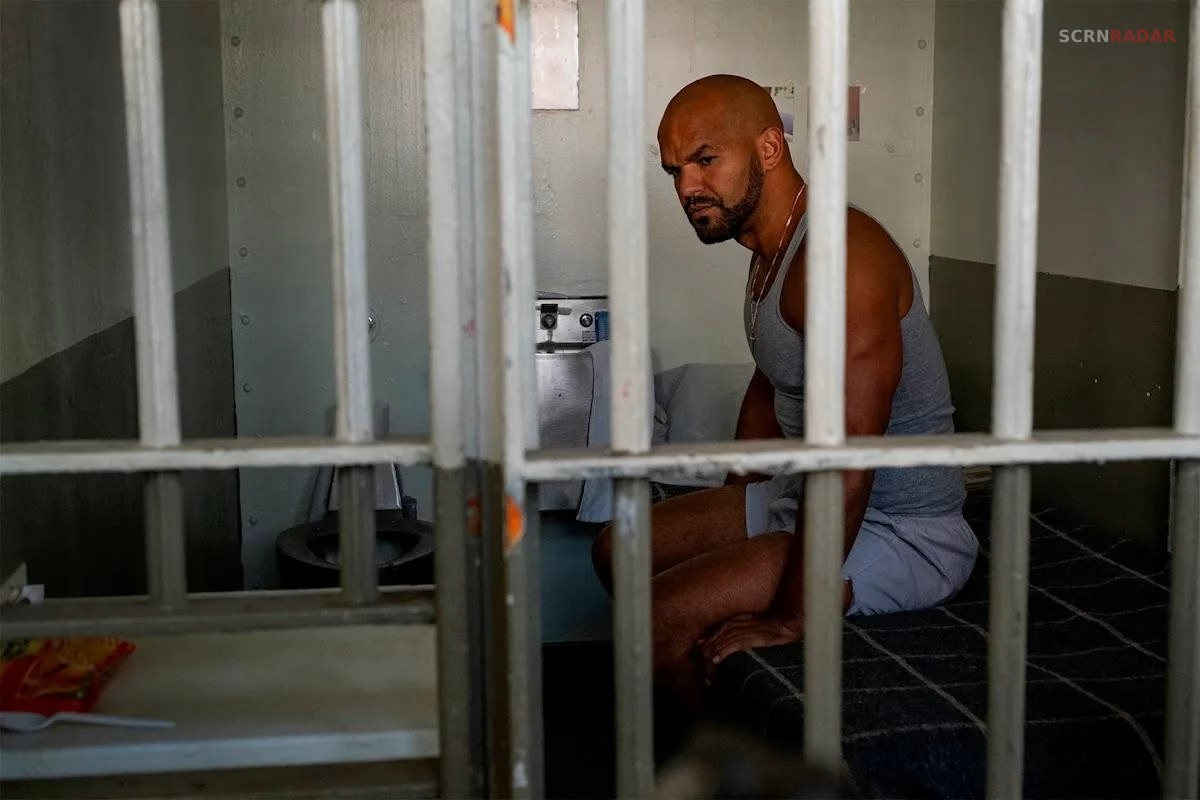
One of Hightown’s greatest strengths has always been its supporting cast, and Season 3 continues that trend through the ongoing rivalry involving Osito and Frankie Cuevas. Amaury Nolasco remains particularly effective as Frankie, whose manipulative personality creates tension even when the character operates from behind bars.
Frankie’s ability to influence events remotely reinforces the show’s theme that criminal systems rarely disappear simply because one person gets arrested. He remains dangerous because of his intelligence and emotional manipulation rather than brute force alone.
Osito’s storyline also continues evolving in interesting ways. Earlier seasons often positioned him as intimidating muscle, but Season 3 gives him more emotional complexity and strategic depth. His shifting alliances and growing ambitions create some of the season’s strongest criminal tension.
The dynamic between Frankie and Osito works because both characters represent different survival philosophies within the criminal world. Frankie thrives through manipulation and emotional control, while Osito increasingly relies on adaptability and calculated pragmatism.
Unfortunately, several of these storylines feel cut short by the ending. Important conflicts appear to be building toward larger consequences, only for the season to conclude abruptly before fully exploring them.
The shortened episode count hurts the finale
One of the most common criticisms surrounding Hightown Season 3 involves its shortened seven-episode structure. Previous seasons had more room to develop character arcs gradually, but the final season often feels compressed and uneven because of limited runtime.
Several critics and viewers noted that the season behaves more like half of a larger story than a fully completed final chapter. Storylines are introduced, expanded, and then left hanging with minimal resolution. The pacing creates the feeling that important material may have been removed or condensed.
This issue becomes particularly noticeable in the final episodes. The narrative suddenly accelerates toward major confrontations and dramatic reveals, but many emotional consequences remain underdeveloped. Instead of feeling like a carefully planned conclusion, the finale often resembles an unexpected cancellation.

Fans on Reddit expressed similar frustration, especially regarding unresolved character arcs and the abrupt nature of the final episode. Some viewers were stunned to discover Episode 7 was actually the series finale because the story still felt mid-transition rather than complete.
The shortened structure ultimately limits the emotional payoff of several major storylines. Jackie’s recovery arc receives meaningful attention, but other characters and criminal conflicts feel rushed or incomplete by comparison.
Jackie’s emotional journey gives the season purpose
Despite structural issues, Jackie’s emotional arc provides the season with a strong thematic center. More than anything else, Season 3 focuses on whether Jackie can finally confront the emotional patterns destroying her life.
Her investigation into missing women becomes symbolic of her need to save people in order to avoid facing herself. The show repeatedly suggests that Jackie’s obsession with rescuing others is connected directly to unresolved trauma and guilt.
This storyline works because the series avoids simplifying addiction into inspirational clichés. Jackie’s recovery process is portrayed as deeply painful and unstable. Relapses, emotional isolation, and self-destructive behavior remain constant threats throughout the season.
Importantly, the show allows Jackie to acknowledge her own flaws more directly than in previous seasons. By the finale, there is at least some sense of emotional progression, even if external storylines remain unresolved.
The emotional focus on Jackie ultimately saves the season from feeling completely directionless. Even when the criminal plots become overcrowded, her internal struggle gives the narrative emotional continuity.